 David Barras (Writer/Director - 'Electric Man')
'The Shocking Story of Electric Man!'
Jazz and Wolf run Edinburgh's Deadhead Comics. They owe their landlord £5,000 but they don’t have it and it seems the shop is doomed. But when Issue #1 of Electric Man mysteriously appears in the shop, it seems their problems are solved.
Far from it!
Worth £100,000, the comic is being sought by a number of people who’ll stop at nothing to get it for themselves - the strange and alluring Lauren McCall; Electric Man obsessive Edison Bolt; and Lauren’s Uncle Jimmy, a violent thug.
Described as The Maltese Falcon meets Clerks, this quirky, Scottish indie is the perfect mix of micro-budget slacker comedy and innovative crime caper.
Chatting recently with Writer/Director David Barras, I first wondered, being that 'Electric Man' is based around the lore of comic books, on a scale of 1 to 10 how much of a comic book geek was he himself? "Twenty years ago I might have went for an 8 or 9, but these days when I go to cons and see the level of geekery, I would hazard that I'd be lucky to scrape a 5."
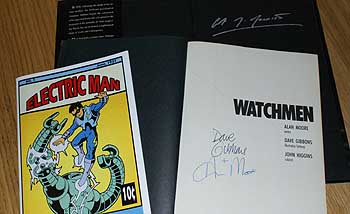
OK, and prove it! "I have signed copies of both Watchmen and Arkham Asylum."
The opening premise of 'Electric Man' is that Jazz and Wolf need money to save their comic book store. So, taking this one step at a time, where did the names Jazz and wolf come from? "Scott Mackay who originally wrote the first draft came up with them. We have a friend called Jazz and Wolf was named after a guy who was in the UK version of Gladiators. But Wolf is a legitimate surname and it works for the character."
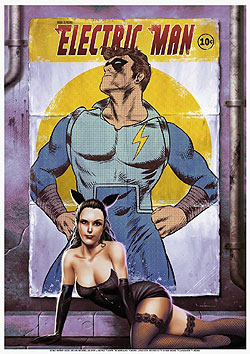
They stumble upon a valuable first edition copy of 'Electric Man' and think all their monetary problems are solved. So, does such a comic book actually exist in real life and if not, where did your inspiration for 'Electric Man' originate? "Electric Man was created for the film although there are plans afoot to bring him to life in a comic of his own (see: www.ElectricManComic.com).
"When the script was first written it was Action Comics No1 which was the driving force behind the plot. When we came to make the film on a very low budget, we realised that negotiating with DC over the image rights to Superman could be a lengthy and costly process. Scott came up with Electric Man and it just clicked for us. We've had great fun with the comic book character within the film, creating an origin, villains and a mythology behind the character."
The story continues that our heroes are not the only ones that want to get ahold of this comic book and soon there are threats from all angles. Chock full of, shall we say old school dastardly villains and femme fatales it quickly turns into a large ensemble piece. Filmed in Edinburgh, Scotland, your homeland, what was the budget for such an ensemble - and did you come in under or over it? "The shooting budget was £55,000 and we came in slightly under, which was all to do with our super heroic Producer Ellen. She did a great job of keeping the schedule on time and the finances on budget."
Was it always to be filmed and set in Scotland, or were there times initially where you considered filming abroad, perhaps? "It was always to be filmed in Scotland. Most of the cast and crew are Edinburgh based so it saved us an enormous amount of money and the Edinburgh backdrops are a major part of the film. The comic shop is also a real comic shop, which we 'borrowed' for the shoot days. Again, saving us major amounts of money."
What were your own TV experiences growing up that seem to - in hindsight - have factored into the end product of 'Electric Man'? "I was born in 1969, so 'Star Wars' was the life changer for me, along with millions of others. TV wise I was a fan of Doctor Who (Tom Baker era), Hitch Hikers Guide to the Galaxy, just anything that was genre."
"Coming of age at the time of VCRs allowed us all to watch and watch countless movies and after 'Star Wars' there was no end of interesting genre films around - from Blade Runnner, The Thing, American Werewolf, Highlander, all those great early eighties movies which had a big impact on me as a teenager."
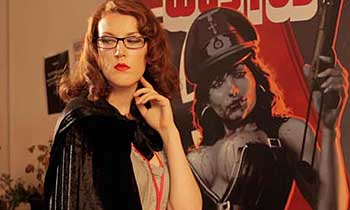
The girls involved - Jennifer Ewing and Emily Lockwood - are getting a lot of praise for their acting roles so where did you find them? "Jennifer is American. We found her by a very weird route. Our cinematographer, Rich Steel had worked with Jen's dad, as the family had lived in Edinburgh for a while. When it came to casting Rich mentioned that Jen was an actress and loved comics. So we sent her a scene for her to try out. She filmed it in a New York Comic Store and in the streets of NY and posted it on YouTube for us to see. We loved it and Jen was Lauren from that point."
"Emily we found from an open audition session. We held an all day casting call in Edinburgh and Emily just walked in and nailed Victoria straight off the bat. She never really had any competition. She can play sexy and funny, which is never easy."
And to bring balance to the gender roles undertaken, Toby Manley and Mark McKirdy are also getting high praise for their acting chops. Again, where were these guys found? "We got Mark from the same open casting session as Emily and again, it was fairly obvious when he came in that he was Wolf."
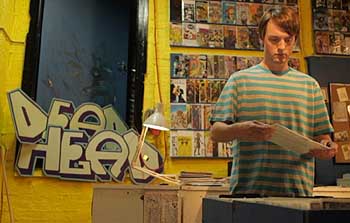
"Jazz, on the other hand, was a nightmare. We could not find the right guy for that role. Many people came close, but no one had that spark we were looking for. We were three weeks away from the shoot when Toby answered an online ad from an acting website. He also uploaded a YouTube audition but we knew it was important he had a rapport with Mark."
"So, we got Toby up from London to do a few scenes and some improv with Mark. And thank God, they hit it off immediately and you could see that they made a great pair. They are now firm friends in real life. You can see all of them audition for their part in the 'Making of' which is on the DVD."
One thing that comes across is that it is hard, at times, for the American's to understand the Scottish drawl. By the time they think they've figured out what just got said the actor has moved on to something else! Did this cross your mind too - for the foreign market - or was it just a battle you knew you would never win so unleashed the accents regardless? "Originally, Emily and Jazz were supposed to be Scottish as well. But because Toby and Emily were so good, we changed their nationalities to English and once you count Lauren and Edison, who're American, you only have Wolf and Jimmy."
"From feedback we've received from US screenings (Port Townsend Film Fest, San Diego Comic Con) most people didn't have a big issue with accents except Uncle Jimmy. And given the physicality of the performance it doesn't seem to matter too much. Essentially, he's menacing and you get that from his body language even if you don't quite catch what he's saying!"
"But, trust me, the accents in our film are nothing compared to a "real" Scottish accent. In the past, films like 'Trainspotting' and 'Gregory's Girl' were dubbed. If we Brits can get into The Wire, with it's Baltimore accent, I think this can flow both ways!"
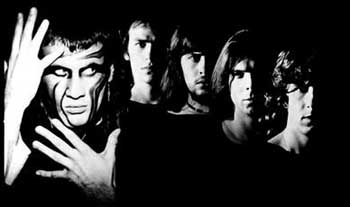
And talk about bringing in someone who stands tall (literally) as a pronounced character actor, you even have the man himself, Fish (aka Derek Dick of Marillion fame) in the film as the aforementioned Uncle Jimmy! How the hell did you get him involved?! "Many people in the US will not be that familiar with Fish. In the eighties, Fish was lead singer in the band Marillion who were massive in the UK and Europe. He's now a solo singer and has just released his 10th solo album, A Feast of Consequences."
"Scott and I were both fans and we were aware he'd acted in 'The Jacket' with Adrian Brody and Daniel Craig and we wanted a imposing presence for Uncle Jimmy. He lives just outside Edinburgh and through a friend, I got him a letter about the project. He called up, said he was interested and after reading the script, he signed up. He does a great job in the film and we got to use two of his songs for the soundtrack. Winner!"
The lack of expensive CGI is more than made up for in the originality and imagination behind, and within the film, but in reflection do you wish this had been a Hollywood movie with a Hollywood budget? "No, I think lack of budget engenders creativity. Don't get me wrong, it would have been nice to pay everyone properly and have catering and a decent production base, etc., but the low budget nature creates a great camaraderie between the cast and crew. And we really had a ball making this film. Next time, however, a bigger budget would be nice!"
And if so, would it have changed the movie completely, do you think? "Yes, it would have and in some ways for the better, undoubtedly, but it is what it is. We made the best movie we could make for the money and time we had available. There'll always be things that niggle about the film for me, but I'm happy with the end result and as long as it entertains people we've done our job."
Looking at the reviews for 'Electric Man,' most all are upbeat, positive and with-you-for-the-low-budget-fun-ride, so to speak. But one says, "... the comedy doesn't come together" and another says "... sapped of energy by clunky editing." So, I was wondering what you would say to these people in response? "Nothing. They're people's opinions. We all have them. If it doesn't work for you it doesn't work for you. Check imdb, every film, no matter how good has a detractor. With reviews you take the good with the bad. I'm just happy that the people we made this film for, seem to really enjoy it and thankfully the majority of the reviews have been very positive."
Tell us more about the hair-raising up-the-kilt shot and how that got accomplished! "Ferdy, who plays Nut Kicker was lying on a large piece of fabric which was pulled under the kilt. Meanwhile, two or three people including myself, were holding a kilt above him. No actor involved. The DoP held the camera down the kilt and Ferdy was pulled under. That whole chase scene took about half a day to film, which on our schedule was relatively long."
And whilst we're talking about how certain shots were accomplished, were there any accidents that occurred during the filming of that stunt-filled bike chase? "The stunt rider came off his bike only once. He went right over the handlebars as he's being chased up the alley by Edison Bolt. You can see it on the Bloopers."
And as you watch the movie back on your own time today which scene gives you the most pleasure - and why? "I like the scene between Victoria, Wolf and Jazz in the bar prior to the bike chase. I never watch the film in my own time as it were, but when I sit through a screening or a film fest I'm always amazed to still catch little nuances from the actors; particularly Toby and Mark. They just inhabit those guys."
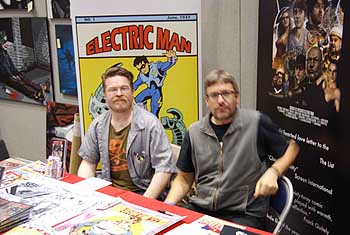
And so that we can give props to them, who created the animated opening credits for 'Electric Man'? And was it always going to be an animated opening? "It was always going to be a title sequence showing the origin of Electric Man. The artwork was by a comic book artist called Graham Manley, who is currently working on the Electric Man comic and the animation was by Andrew Murchie and Susanna Murphy. Once we added the Fish song and the sound effects we had an attention grabbing opening to kick off with."
And finally, and yes we ask everyone this question, we here at Exclusive Magazine love Penguins (the birds) - so I was wondering if you yourself had any love for them, or any personal stories? "Two things about Penguins. Here in Edinburgh, we have a Penguin Parade at the Zoo every day which always entranced me as a child as it was a chance to get relatively close to animals out of their enclosures."
"And secondly, in the UK a Penguin is a biscuit - and boy did I love those biscuits!!"
Interviewed by: Russell A. Trunk
www.ElectricManMovie.com
Electric Man Trailer
www.ElectricManComic.com
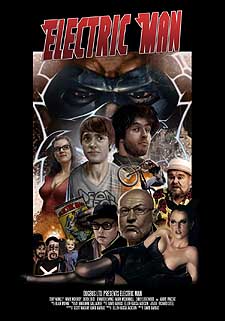
If you would like to win an AUTOGRAPHED 'ELECTRIC MAN' limited edition poster, just answer this question about the lore of the comic book world: In what issue did Sabretooth first appear?
1) Iron Fist #14
2) Wolverine #3
3) Uncanny X-Men #115
4) Avengers Annual #5
One (1) entry only per email address, thank you!
Send us your answers and if you're correct you'll be in the running to win an AUTOGRAPHED 'ELECTRIC MAN' limited edition poster! Just send us an e:mail here before November 15th with your answer and the subject title CONTEST: SIGNED ELECTRIC MAN POSTER to: exclusivemagazine@flash.net
Back To Archives