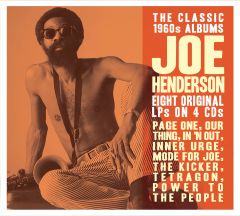
Title - Joe Henderson - The Classic 1960s Albums [4CD]
Artist - Joe Henderson
For those unaware, Joe Henderson was a visionary jazz saxophonist and whose powerful tone and fearless improvisation helped shape modern post-bop. His work bridged hard bop and avant-garde jazz, influencing generations of musicians with its intellect, soul, and restless creativity.
Henderson played with many of the leading American players of his day and recorded for several prominent labels, including Blue Note, Milestone, Contemporary Records and Verve, enjoying a lengthy musical career spanning more than four decades.
This collection brings together the very finest albums on which Joe Henderson performed as a leader, released throughout the 1960s. A superb starting point for listeners new to Joe’s sound, and a welcome reminder for everyone else.
CD 1:
Page One (1963)
Blue Bossa
La Mesha
Homestretch
Recorda Me
Jinrikisha
Out Of The Night
This album, recorded in June 1963, was Henderson’s (tenor sax) first recording as a leader for the Blue Note label, and features Kenny Dorham (trumpet), McCoy Tyner (piano), Butch Warren (bass) and Pete La Roca (drums). Half of the material here, although very enjoyable to listen to, is not as inspired as we might expect considering the personnel at hand.
One of the problems is the relatively short duration of most of many of the solos herein, denying the improvisor the opportunity to explore and develop a myriad of moods and dynamics - a crucial element of any purposeful, emotional offering.
So let’s say that none of the performers are consistently at their best in this session, yet there are at least two works here of great significance - Jinrikisha and Out Of The Night. The other stuff is good, but these two are simply great.
Our Thing (1964)
Teeter Totter
Pedro’s Time
Our Thing
Back Road
Escapade
Our Thing, from 1963, followed Henderson’s Page One and Dorham’s Una Mas in the series, and the closeness shows in the aplomb with which they navigate each other’s challenging tunes. Henderson was already developing an inside-outside approach, moving in and out of chord changes with broad freedom, adding split-tones to his phrases with telling effect on his own Teeter Totter and on Dorham’s beautiful Escapade. He gets added stimulus from Andrew Hill, a highly original pianist who’s making his recording debut here.
Whether he’s soloing or comping, Hill has a knack for abstracting the contours of a piece, adding close-voiced chords and sudden flashes of melody to point in other directions. Dorham’s Pedro’s Time is a long blues with a Latin feel that recalls his Una Mas or Blue Bossa, and it highlights the fine playing of bassist Eddie Kahn and drummer Pete La Roca.
CD 2:
In ’N Out (1964)
In ’N Out
Punjab
Serenity
Short Story
Brown’s Town
This is the fourth recording as a leader for Blue Note, dating from April 1964, and chronicles the continuing emergence of Henderson as a major force in the paradigm of mid-sixties jazz. The session includes the accomplished Kenny Dorham (trumpet), and a wondrous rhythm section of Coltrane’s school, consisting of the still-emerging McCoy Tyner (piano), Richard Davis (bass) and the incomparable Elvin Jones (drums).
Still one album shy of full maturity, Henderson is nonetheless obligingly powerful and emotional during most of the session. Kenny’s sound and style is quite different from that of Freddie Hubbard and Lee Morgan, the ubiquitous trumpeters on the Blue Note sessions of this era, and Kenny provides a seasoned, mature and inventive sound that is indeed a pleasure to listen to.
Inner Urge (1964)
Inner Urge
Isotope
El Barrio
You Know I Care
Night And Day
By going to a four-piece, Henderson puts himself out in front as the sole horn, delivering tumbling, dark hard bop on this one. Not the first choice for the casual fan - that would have to be Page One - but this is the first he did without his mentor (the perennially underrated Kenny Dorham), and as such is a move toward a more personal statement. If you’re building a Blue Note hard bop collection, though, you’ll want this one.
CD 3:
Mode for Joe (1966)
A Shade Of Jade
Mode For Joe
Black
Caribbean Fire Dance
Granted
Free Wheelin’
This is Henderson at his very best, a timeless absolute classic Blue Note LP. Joe was underknown to the vast majority of the Jazz audience and like Hank Mobley was overshadowed by the gigantic figures cast by John Coltrane and Sonny Rollins. Henderson is every bit as inventive and terrific as anyone in the history of the tenor sax. If you have never heard this fabulous LP, don’t hesitate one second to get it.
The musicians accompanying Joe on this one are all fantastic and Lee Morgan and Bobby Hutcherson simple sparkle. This a moment of brilliance in the history of recorded jazz. Absolute MUST HAVE in any jazz collection.
The Kicker (1968)
Mamacita
The Kicker
Chelsea Bridge
If
Nardis
Without A Song
O Amor Em Paz (Once I Loved)
Mo’ Joe
His debut, The Kicker, was an auspicious first album for his new connections. At the time Henderson had been working in a cooperative with trumpeter Freddie Hubbard and drummer Louis Hayes, and Hayes was the drummer on The Kicker. Veteran bassist Ron Carter and the talented pianist Kenny Barron completed the rhythm section, while trumpeter Mike Lawrence and trombonist Grachan Moncur joined Henderson on the frontline. Henderson wrote several songs, including the title track, for the album.
CD 4:
Tetragon (1968)
Invitation
R.J.
The Bead Game
Tetragon
Waltz For Zweetie
First Trip
I’ve Got You Under My Skin
Henderson’s Tetragon is a record of substance. It is the work of musicians who know what they are doing, know why they are doing it, and have no interest in reducing the music to gesture or effect. There is strength here, but also restraint. The performances are exploratory without becoming diffuse and disciplined without becoming rigid.
The title composition provides a particularly strong vehicle. Its structure is demanding enough to engage the full attention of the group, yet open enough to permit genuine movement within it. The result is music that remains organized while still allowing for discovery. That is no small achievement. In lesser hands, material of this sort can become either mechanical or vague. Here it remains alive.
Henderson’s sound is central to the identity of the album. His tenor does not depend on weight or display. It is focused, incisive, and immediately recognizable. He had the ability to move through difficult harmonic territory with ease, but he did not call attention to the difficulty. What one hears instead is purpose. Each phrase belongs to a continuing statement.
Power to the People (1969)
Black Narcissus
Afro-Centric
Opus One-Point-Five
Isotope
Power To The People
Foresight And Afterthought (An Impromptu Suite In Three Movements)
Recorded during 1969 and has some similarities to the early fusion that was occurring at the time which includes Herbie Hancock playing electric piano on three different cuts. However, the rest of the album has songs very similar to the style of Miles Davis’ second great quintet which was played in a post bop setting. It’s no coincidence that three of the band members were either currently or formerly employed by Miles.
The opening tune, Black Narcissus is my favorite from the album. It is a ballad that finds Henderson in a quartet setting that includes Hancock on the electric piano. Henderson, who at times can have a very strong sounding tenor plays so gently as Hancock comps on his solo. The two tracks titled Afro-Centric and Power to the People have a slight fusion feel to them because of the electric piano and electric bass but it’s still basically straight ahead jazz.
I enjoyed both of those songs not only because of Henderson but because of a relatively unknown trumpeter by the name of Mike Lawrence whose only appearance on the album is on those two tracks.
Official Purchase Link
www.mvdshop.com










 Title - Joe Henderson - The Classic 1960s Albums [4CD]