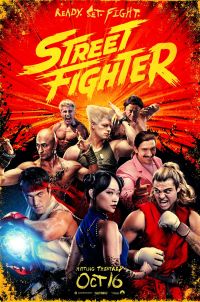
Street Fighter
(Noah Centineo, Andrew Koji, Callina Liang, Joe “Roman Reigns” Anoa’i, David Dastmalchian, Cody Rhodes, Eric André, Andrew Schulz, Vidyut Jammwal, Curtis “50 Cent” Jackson, Jason Momoa, et al / PG-13 / 1hr 59mins / Paramount Pictures)
Overview: Estranged street fighters Ryu and Ken Masters get thrown back into combat when the mysterious Chun-Li recruits them for the next World Warrior Tournament - a brutal clash of fists, fate and fury. However, behind the battle royale lies a deadly conspiracy that forces them to face off against each other and the demons from their past.
Verdict: For a franchise built around the simple pleasure of watching colorful personalities beat the living daylights out of one another, Street Fighter demonstrates an astonishing inability to understand what makes its source material entertaining. Director Kitao Sakurai’s long-awaited adaptation arrives armed with an enormous ensemble, elaborate costumes, spectacular martial arts choreography, and decades of gaming nostalgia, only to squander almost every advantage on a screenplay of staggering ineptitude.
What should have been a gloriously ridiculous celebration of arcade combat instead becomes an exhausting procession of atrocious dialogue, childish humor, and narrative decisions that grow more bewildering with every passing minute. There are occasional flashes of genuine filmmaking prowess buried within this chaotic production, but extracting them from almost two hours of increasingly insufferable nonsense requires considerably more patience than the film deserves.
Set in 1993, the story reunites estranged martial artists Ryu (Andrew Koji) and Ken Masters (Noah Centineo), whose once-close relationship fractured following a traumatic confrontation with the formidable Akuma (Joe Anoa’i) six years earlier. Their paths converge when the mysterious M. Bison (David Dastmalchian) organizes a World Warrior tournament, attracting an assortment of fighters from across the globe.
Undercover Interpol agent Chun-Li (Callina Liang), meanwhile, is determined to expose Bison’s sinister activities and avenge her father’s death. Beneath the competition lies a scheme involving Bison’s desire to acquire Ryu’s extraordinary power, drawing the reluctant fighter into a confrontation with consequences supposedly extending far beyond the tournament itself.
It’s an uncomplicated foundation for an action film, which makes the screenplay’s determination to complicate absolutely everything all the more baffling. Rather than embracing the tournament as its narrative centerpiece, Street Fighter treats the competition as little more than an inconvenient mechanism for assembling its enormous cast. The individual matches possess precious little dramatic significance, while the larger storyline becomes increasingly preoccupied with Bison’s supernatural ambitions and Ryu’s exceptional abilities.
Character rivalries are introduced without meaningful development, anticipated confrontations are abbreviated or abandoned, and the tournament’s structure never generates the escalating excitement such a premise practically demands. The result is a film that repeatedly gestures towards its most obvious source of entertainment while stubbornly refusing to make it matter.
This fundamental misunderstanding becomes particularly frustrating when considering how straightforward an enjoyable adaptation could have been. The games have already supplied an abundance of distinctive characters, fighting styles, and rivalries, leaving the filmmakers with the comparatively manageable task of constructing a coherent narrative around them.
Instead, Sakurai and co-writer T. J. Fixman bury those possibilities beneath a convoluted collection of half-developed subplots that rarely amount to anything substantial. The screenplay seems convinced that adding more complications automatically creates greater narrative depth, when the opposite proves painfully true.
The dialogue is frequently atrocious, alternating between clumsy exposition, painfully obvious observations, and lame jokes that land with all the elegance of a missed uppercut. Characters announce their motivations with remarkable regularity, apparently concerned that audiences might forget who they are or why they’ve entered the story. Yet all this explanation produces astonishingly little meaningful character development.
Ryu remains the solemn warrior burdened by his past, Ken the swaggering counterpart whose confidence masks familiar insecurities, and Chun-Li the determined heroine pursuing revenge. These archetypes are perfectly serviceable starting points, but the screenplay barely progresses beyond them. Their emotional conflicts are presented as inherently compelling without ever being afforded the attention necessary to make them resonate.
Koji at least possesses the physical credibility and stoic presence required of Ryu, while Centineo brings an occasionally appealing swagger to Ken. Their contrasting temperaments offer the closest thing the film has to a recognizable emotional center, although the material rarely allows either performer to develop much beyond surface-level characterization.
Liang demonstrates considerable athletic ability as Chun-Li, but her dramatic contributions are undermined by particularly cumbersome dialogue and an increasingly perfunctory revenge storyline. Dastmalchian certainly understands the exaggerated theatricality required of M. Bison, yet even his commitment cannot transform the villain’s muddled ambitions into something remotely threatening. For all the talent assembled, the performances are largely stranded within a narrative that mistakes familiar character traits for actual personalities.
The supporting ensemble fares even worse. Jason Momoa’s Blanka, Cody Rhodes’ Guile, Orville Peck’s Vega, Curtis Jackson’s Balrog, and Olivier Richters’ Zangief are among the recognizable figures competing for attention, but their appearances frequently resemble elaborate introductions rather than meaningful contributions to the story. Some receive fleeting opportunities to showcase their abilities, while others seem to exist primarily so audiences can recognize another familiar name or costume.
The film becomes an increasingly overcrowded parade of characters whose inclusion rarely serves any discernible purpose. It’s an impressive achievement of sorts to assemble so many distinctive personalities and render the majority of them almost entirely forgettable. Rather than allowing its ensemble to generate excitement through competing motivations and relationships, Street Fighter reduces much of its cast to glorified background decoration.
Even more exhausting is the film’s relentless reliance on crass, juvenile humor. There’s nothing inherently wrong with embracing the ridiculousness of a franchise populated by impossibly muscular fighters, supernatural abilities, and extravagantly theatrical villains. Indeed, a healthy sense of humor should be essential to an adaptation of this material.
Unfortunately, Sakurai’s film repeatedly favors immaturity over irreverence, filling its dialogue with tiresome innuendo, obvious punchlines, and awkward comedic exchanges that become progressively more irritating. The jokes aren’t merely unsuccessful. Their sheer frequency actively undermines the film’s attempts to establish dramatic tension, ensuring that potentially meaningful moments are regularly interrupted by another desperate bid for adolescent laughter. It’s a tonal balancing act the filmmakers never come close to mastering.
Thankfully, the film possesses one undeniable strength in its impressively crafted fight choreography. When the characters finally stop talking and start throwing punches, Street Fighter briefly becomes the exhilarating action spectacle it should have been all along. The combat sequences demonstrate considerable technical precision, athletic commitment and an understanding of the exaggerated physicality associated with the games.
Distinctive fighting styles and signature abilities referenced from the games are incorporated with admirable flair, while the performers approach the demanding choreography with convincing intensity. These sequences possess a kinetic energy largely absent from the surrounding storytelling, offering fleeting reminders of the enormous entertainment potential inherent in the material. Frustratingly, their quality only makes the screenplay’s decision to marginalize the tournament feel even more inexplicable.
The film’s other genuine triumph arrives through its beautifully animated flashback sequences, overseen by animation supervisor Young Heller. Rendered in striking anime-inspired imagery, these passages possess a visual confidence, stylistic personality, and emotional immediacy that the live-action material struggles to replicate. The heightened aesthetic feels perfectly suited to the franchise’s exaggerated characters and supernatural mythology, allowing the filmmakers to embrace the source material’s distinctive sensibilities without the awkward limitations of physical realism.
They’re easily among the most visually captivating moments in the entire production, which raises an uncomfortable question about whether Street Fighter might have been considerably more successful as a full-length anime feature. Animation certainly wouldn’t have rescued such a dreadful screenplay, but these sequences suggest an artistic direction far more compelling than the confused spectacle surrounding them.
The film’s nostalgic presentation provides another curious mixture of pleasures and frustrations. Its soundtrack offers an enjoyable selection of recognizable 1990’s music, supplying occasional bursts of energy to proceedings that otherwise struggle to generate much excitement. Unfortunately, the filmmakers demonstrate a surprisingly careless relationship with their own explicitly established 1993 setting.
The inclusion of The Offspring’s “Come Out and Play”, released in 1994, is already a conspicuous chronological misstep, but the appearance of Baha Men’s “Who Let the Dogs Out”, released in 2000, as Ken’s arena entrance music is particularly bewildering. Apparently, the filmmakers were so busy remembering the 1990s that they forgot which part of the decade they were supposed to be honoring.
At almost two hours, the cumulative effect of these shortcomings becomes genuinely punishing. The pacing is particularly peculiar, devoting substantial stretches to establishing motivations and conflicts that ultimately contribute precious little to the narrative, while rushing through the confrontations that might have justified the considerable runtime. Scenes repeatedly introduce information without developing it, characters disappear for extended periods, and the supposed central competition struggles to maintain any coherent momentum.
The film isn’t necessarily lacking in incident, but activity and entertainment are hardly interchangeable. Eventually, the relentless barrage of exposition, flat humor, and narrative distractions becomes so wearying that even the prospect of another impressively choreographed fight offers diminishing relief. Rather than anticipating what might happen next, the overriding sensation becomes an increasingly desperate desire for the ordeal to conclude.
And when that conclusion finally approaches, Street Fighter somehow discovers one final opportunity to test the audience’s patience. Without revealing the specifics, the ending prioritizes the prospect of future instalments over delivering anything resembling a satisfying resolution to the film we’ve just endured. The final scene functions less as a meaningful culmination than an audacious piece of sequel bait, effectively asking audiences to invest in another chapter before demonstrating why this one deserved their attention.
It’s a particularly presumptuous decision for an adaptation that has spent almost two hours failing to establish compelling characters, coherent stakes, or a worthwhile central conflict. The suggestion that this exhausting experience might merely be the beginning is less an exciting promise than an elaborate threat.
Perhaps the most dispiriting aspect of Street Fighter is how thoroughly it squanders the considerable potential of its source material. The characters are visually distinctive, the mythology is expansive, and the fundamental concept offers almost limitless opportunities for thrilling action. Through the accomplished choreography and gorgeous animated interludes, Sakurai demonstrates that the production possesses the technical talent necessary to deliver something genuinely exciting.
Yet these isolated accomplishments are repeatedly overwhelmed by a screenplay that seems fundamentally uninterested in the very elements that make the franchise appealing. The film has all the ingredients for gloriously entertaining action escapism, but its creative decisions ensure they never come together into anything resembling a satisfying whole.
Street Fighter is a spectacularly misguided adaptation. Its impressive fight choreography and striking anime sequences offer occasional glimpses of the far more entertaining film this material might have become. Still, they’re nowhere near enough to offset the atrocious dialogue, incoherent storytelling, and exhausting lack of dramatic purpose.
For a movie supposedly devoted to the art of combat, Street Fighter spends an extraordinary amount of time avoiding the very fight it was created to deliver. And when the final bell eventually rings, the overwhelming feeling isn’t exhilaration or triumph. It’s relief. [D.J.]










 Street Fighter